
In his book series, Journey Through the Text of ‘A Course in Miracles’, Kenneth Wapnick suggests that the Course’s structure resembles that of a symphony, with the introduction, setting aside, reintroduction, and development of a theme. This structure occurs over four ‘movements’ in symphonies, the transition between each marked by a period of silence (in which no one applauds. I found out the hard way).
Much of the scope of the Course’s first movement lies in the Text’s opening sentence, the first of fifty miracle principles outlined in Chapter One:
‘There is no order of difficulty in miracles. One is not “harder” or “bigger” than another. They are all the same. All expressions of love are maximal’ (T-1.I:1).
To understand this principle is to understand a great deal about the Course. But when we read it for the first time, we don’t yet know what a miracle is. If we think of miracles as the magical things Jesus did in the Bible, we might assume the principle runs along those lines, and so it wouldn’t strike us. It would seem too familiar, perhaps even mundane. But when we realise that the Course’s miracle relates to experiencing inner peace regardless of circumstance, then we see the remarkable nature of the principle: it reflects the opposite of the ego thought system which says that we are what the world makes of us.
Later in the Text, we learn that there is no order of difficulty in miracles because there is no hierarchy of illusions: one is no less real than any other, none harder to overcome or see past. This reflects another Course theme: the non-dual nature of Reality. The world of division, hatred and decay is an illusion, a dreamworld, and we are the dreamer of the dream. This dream is based on a belief that we have separated from God, and the shame and guilt this engenders is the ultimate cause of our distress.
The miracle occurs when we choose to question the causative role that circumstances play in our despair, redirecting our attention to our mind where we can choose to let the Holy Spirit, the link to Truth, undo our belief in separation. This is the Course’s process of forgiveness, which involves removing our projections of guilt from others for how we feel. The miracle is the choice to question our judgements, and the ‘miraculous’ result.
What makes forgiveness seem harder in some circumstances is the value we place on a particular grievance for keeping our attention rooted to the world, in effect keeping our ego identification intact:
‘It is impossible that one illusion be less amenable to truth than are the rest. But it is possible that some are given greater value, and less willingly offered to truth for healing and for help. No illusion has any truth in it. Yet it appears some are more true than others, although this clearly makes no sense at all. All that a hierarchy of illusions can show is preference, not reality’ (T-26.VII.6:1-5).
We cling to some illusions because we have given them greater value in terms of their perceived capacity to cause our unworthy self-concept and lack of peace. To let go of that special grievance would be the choice to truly accept the first miracle principle and the non-dual nature of Reality. We would no longer be bound to the past and our associated self-concept. Our eyes would begin to open.
In short, the attraction to believing in a hierarchy of illusions is formidable because we are resistant to waking up. And so, we need something to rouse us from our slumber, a shock to the system. While the first miracle principle might not hit us with a bang on our initial read, it stands as a loud wake up call, which, if we let it, can strike us with all the import of Beethoven’s ‘Da, da, da, dum!!’, the famous four notes beginning his Fifth Symphony, and which he said represented ‘Fate knocking at the door’.
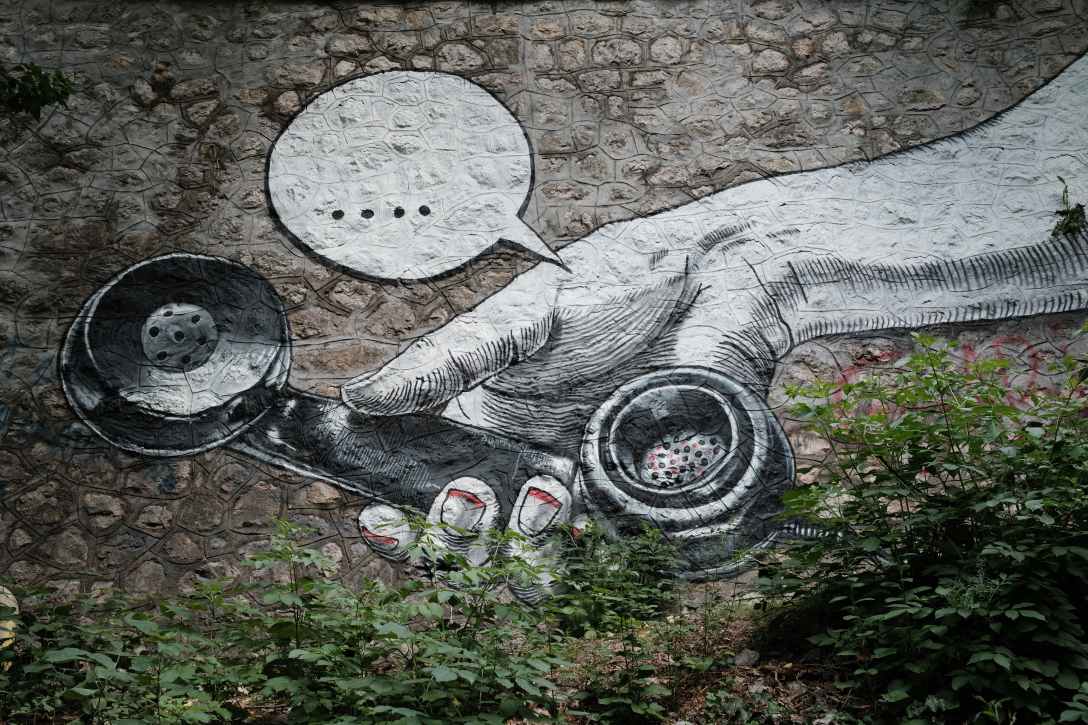
Image: Photo by Axel Grollemund, via Pexels.
Books by Stephanie Panayi
Above the Battleground: The Courageous Path to Emotional Autonomy and Inner Peace
The Bridge of Return: A Course in Miracles as a Western Yoga
The Farthest Reaches of Inner Space
Reflections on ‘A Course in Miracles’: Volume One
Reflections on ‘A Course in Miracles’: Volume Two
 Reflections on A Course in Miracles