
Frederick McCubbin was an Australian artist and member of the Heidelberg School art movement during the late nineteenth and early twentieth century. The movement is also known as Australian impressionism, and I find McCubbin’s work particularly evocative of the early settlers’ experience in the Australian bush. Isolation is a familiar theme, with several paintings depicting a single person, alone within a vast landscape.
Of particular note are two paintings which struck me when I first saw them as a teenager. Both are titled Lost, and were composed twenty-one years apart. The first, painted in 1886, depicts a young girl standing in the midst of towering eucalypts, her head down, the back of one hand near her brow in a forlorn gesture. I remember feeling a connection with this girl. Who can’t relate to feeling lost without any idea of where to turn? It’s so existential. And then, of course, I was a teenager.

Lost, 1886, Frederick McCubbin, National Gallery of Victoria
Near the lost girl, was the lost boy of 1907. He was a more pronounced figure of frustration. I imagined him to have been trudging through the forest with a stick in hand for hours, perhaps days, but all to no avail. This painting didn’t evoke the existential kind of loneliness that the lost girl, standing bewildered, did. To me, the boy suggests that feeling you get when you’ve tried and tried and tried, but no matter what you did, you couldn’t find your way through.

Lost, 1907, Frederick McCubbin, National Gallery of Victoria
The girl’s state was a pure reflection of her circumstance: lost and alone in a vast wilderness; the boy seemed to suggest a defeated will. He’d given something a red hot go, and had come up empty-handed. In this, the lost boy reminds me of another of McCubbin’s paintings, Down on His Luck. Painted in the period between the two Lost paintings, we see a nomadic swagman, his billycan upturned, no food or treasures around the fire, his swag piled beside him. Perhaps he’s been looking for work, as swagmen did, or hoping to catch a meal. Whatever his aim, he’s been unsuccessful. He sits staring into the fire, defeated.
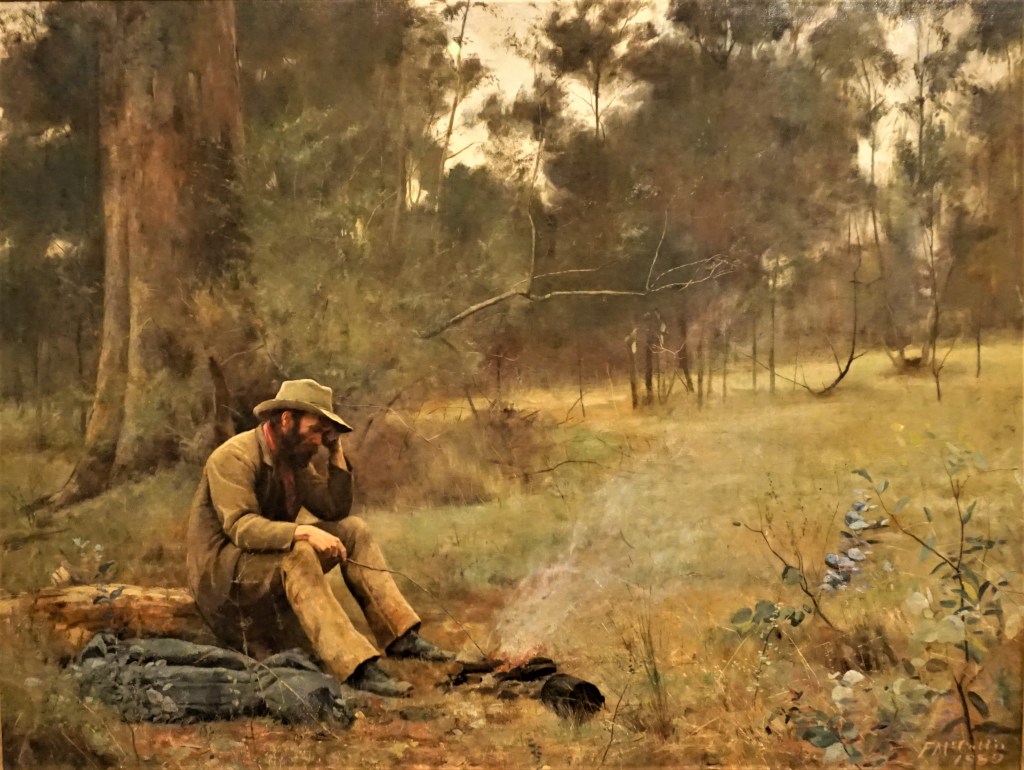
Down on His Luck, 1889, Frederick McCubbin, Art Gallery of Western Australia
I love the relatableness of McCubbin’s subject-matter, and his subtle impressionistic style. The emotional state of his isolated figures is what shines through, poignantly touching the observer. Lost, down on your luck — it all feels so helpless.
The theme of helplessness reminded me of Neil Young’s song ‘Helpless’, released in 1970. It includes fond reminiscences of his childhood home in Ontario. ‘Helpless’ appears to be a homage to a lost place of security and comfort. In the adult world of responsibilities and commerce, the door seems chained and barred to that tranquil past.
Helpless, feeling lost and down on our luck, we feel powerless to change our circumstances, but perhaps our feelings of helplessness are really about nostalgia; a yearning for an idyllic past that, no matter what we do, we can’t seem to return to. The following passage from A Course in Miracles speaks to this yearning:
‘This world you seem to live in is not home to you. And somewhere in your mind you know that this is true. A memory of home keeps haunting you, as if there were a place that called you to return, although you do not recognise the voice, nor what it is the voice reminds you of…
We speak today for everyone who walks this world, for he is not at home. He goes uncertainly about in endless search, seeking in darkness what he cannot find; not recognising what it is he seeks. A thousand homes he makes, yet none contents his restless mind. He does not understand he builds in vain. The home he seeks can not be made by him. There is no substitute for Heaven’ (W-182.1: 1-3; 3: 1-6).
We yearn for our Home, looking to the world to provide Its comfort, love and constancy. But the world can’t give us that, no matter what product, career, relationship, or project it markets as a solution. Our home and our Self reside within:
‘No pathway in the world can lead to Him, nor any worldly goal be one with His… All roads that lead away from what you are will lead you to confusion and despair…’ (T-31.IV.9: 2, 5).
Feeling lost reflects the belief that we have separated from God; feeling down on our luck reflects the idea that God has abandoned us. These thoughts relate to guilt and shame: guilt in believing we separated from God, attacking His Oneness; shame in feeling incomplete, not good enough for God’s special favour or a ‘lucky break’ (It’s not fair…). The nostalgia for home is therefore also a yearning for our wholeness, grandeur, and innocence: ‘You have not lost your innocence. It is for this you yearn. This is your heart’s desire’ (W-182.12: 1-3).
When we feel lost and helpless, we can picture McCubbin’s characters and remember that the cause of our distress is that we have wandered away from the home within our mind, and the answer is to return — to ‘be still an instant and go home’, as the Course’s Workbook Lesson 182 suggests. This lesson uses the symbology of a child, far from home, needing our protection and help to return. This child is both our innocence and our Self; a Child ‘Who seeks His Father’s house’:
‘It is this Child Who knows His Father. He desires to go home so deeply, so unceasingly, His voice cries unto you to let Him rest a while. He does not ask for more than just a few instants of respite; just an interval in which He can return to breathe again the holy air that fills His Father’s house. You are His home as well. He will return. But give Him just a little time to be Himself, within the peace that is His home, resting in silence and in peace and love’ (W-182.5:2-7).
Yet it can be difficult to hear this Child’s call ‘amid the grating sounds and harsh and rasping noises of the world’. When our mind wanders into the world to defend us from shame and guilt — by trying to amass wealth or fame or approval, for example — we have become lost, and as long as our attention remains fixed on the world as containing the problem and the solution, the Child’s call is silenced. At least when our plans fail and we feel helpless, we might be motivated to stop and reset. When we can’t see a way forward we are left with the only ‘real alternative’ to dreams of fear: we can remember that our distress is a form of nostalgia; we can abandon our mind’s frantic activity and answer our true yearning:
‘When you are still an instant, when the world recedes from you, when valueless ideas cease to have value in your restless mind, then will you hear His Voice. So poignantly He calls to you that you will not resist Him longer...
… Be still an instant and go home with Him, and be at peace a while.‘
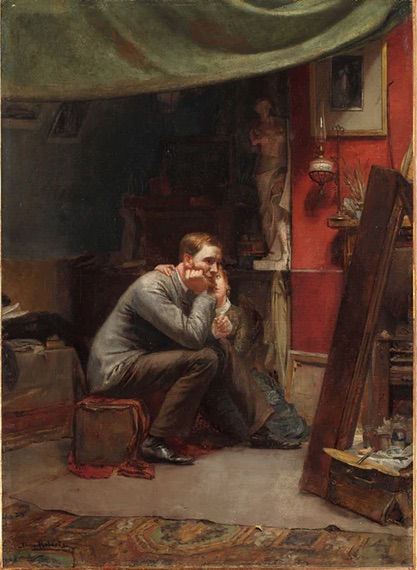
Image: Rejected, 1876, by Tom Roberts, via Wikimedia Commons
Books by Stephanie Panayi
Above the Battleground: The Courageous Path to Emotional Autonomy and Inner Peace
The Bridge of Return: A Course in Miracles as a Western Yoga
The Farthest Reaches of Inner Space
Reflections on ‘A Course in Miracles’: Volume One
Reflections on ‘A Course in Miracles’: Volume Two
 Reflections on A Course in Miracles